
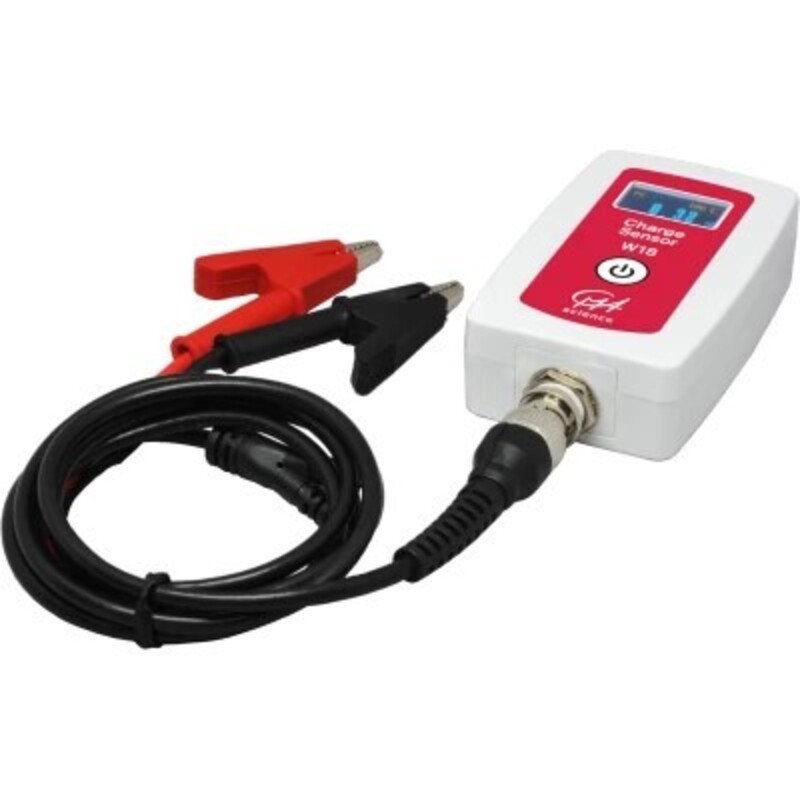
The CMA wireless charge sensor is designed to measure electrostatic charges in three ranges: -5 to +5 nC, -20 to +20 nC, and -100 to +100 nC. It can replace a traditional electroscope by not only showing the polarity of the charge, but also performing quantitative measurements. The sensor comes with a shielded BNC/alligator clip. The cable ends with a red and black alligator clip.
The charge sensor is equipped with an OLED colour display that shows sensor information and the measured values. This makes the sensor suitable for use as a stand-alone measuring instrument.
This wireless charge sensor can be used wirelessly via Bluetooth or wired via USB with the Coach 7 or Coach 7 lite programmes/apps on computers (Windows and Mac), Chromebooks and mobile devices (Android and iOS).
By default, the charge sensor uses the range of ± 100 nC. Briefly press the on/off button to select a different range. For accurate sensor detection in the Coach software, first select the desired range before connecting the sensor.
The charge sensor comes with a factory calibration in nC. To discharge the sensor, press the on/off button twice while the cables are short-circuited.
Technical specifications:
-Measuring ranges: ± 5 nC / ± 25 nC / ± 100 nC
-Resolution: 0.003 NC / 0.01 nC / 0.05 nC
-Maximum voltage: ± 150 V
-Input impedance: 1 MΩ
-Warranty: 36 months
-OLED display: 0.96" 128 x 64px
-Maximum sample frequency: 10 Hz
-Battery life: 4 hours when fully charged (rechargeable)
-Connection: Bluetooth 5, Low Energy (Mac, Android, iOS) Bluetooth 2.1, Classic (Windows) or USB-C 2.0
-All sensor specifications can be found in the Manual, see Downloads.
Suggestions for physics practicals:
-Measure the electrostatic charge created by rubbing a balloon over different fabrics
-Compare the charge on a plastic rod after rubbing it with wool to that on silk
-Measure how distance affects the measured charge between two objects
-Investigate the charge build-up on a glass rod after repeated rubbing
-Test how grounding an object affects the measured electrostatic charge
-Measure the charge on different materials such as PVC, rubber and acrylic after rubbing
-Investigate charge induction by bringing a charged object close to a neutral conductor
-Observe how humidity affects the build-up of electrostatic charge on a material
The charge sensor is equipped with an OLED colour display that shows sensor information and the measured values. This makes the sensor suitable for use as a stand-alone measuring instrument.
This wireless charge sensor can be used wirelessly via Bluetooth or wired via USB with the Coach 7 or Coach 7 lite programmes/apps on computers (Windows and Mac), Chromebooks and mobile devices (Android and iOS).
By default, the charge sensor uses the range of ± 100 nC. Briefly press the on/off button to select a different range. For accurate sensor detection in the Coach software, first select the desired range before connecting the sensor.
The charge sensor comes with a factory calibration in nC. To discharge the sensor, press the on/off button twice while the cables are short-circuited.
Technical specifications:
-Measuring ranges: ± 5 nC / ± 25 nC / ± 100 nC
-Resolution: 0.003 NC / 0.01 nC / 0.05 nC
-Maximum voltage: ± 150 V
-Input impedance: 1 MΩ
-Warranty: 36 months
-OLED display: 0.96" 128 x 64px
-Maximum sample frequency: 10 Hz
-Battery life: 4 hours when fully charged (rechargeable)
-Connection: Bluetooth 5, Low Energy (Mac, Android, iOS) Bluetooth 2.1, Classic (Windows) or USB-C 2.0
-All sensor specifications can be found in the Manual, see Downloads.
Suggestions for physics practicals:
-Measure the electrostatic charge created by rubbing a balloon over different fabrics
-Compare the charge on a plastic rod after rubbing it with wool to that on silk
-Measure how distance affects the measured charge between two objects
-Investigate the charge build-up on a glass rod after repeated rubbing
-Test how grounding an object affects the measured electrostatic charge
-Measure the charge on different materials such as PVC, rubber and acrylic after rubbing
-Investigate charge induction by bringing a charged object close to a neutral conductor
-Observe how humidity affects the build-up of electrostatic charge on a material
Show more
Properties
- CMA/W18