
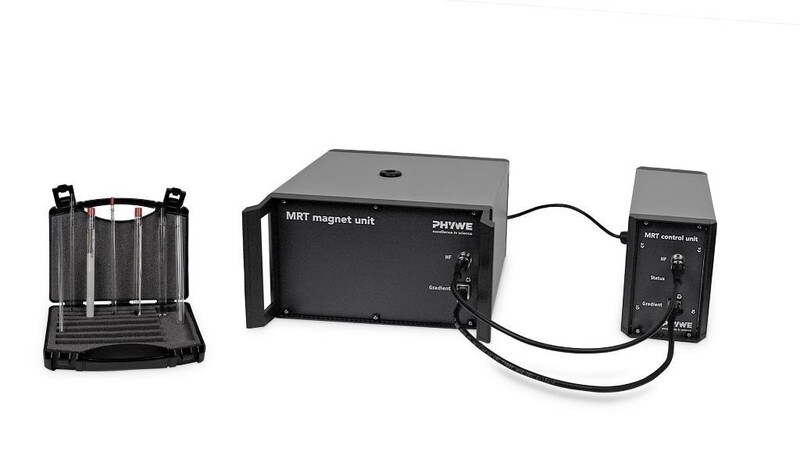
The aim is to demonstrate and investigate how spatial coding works in MR technology. The experiments are carried out using the MRI training device, which allows smaller samples to be examined directly in a sample chamber. The device is controlled using the software supplied. The investigations include the generation of 1D spatial encoding by means of an additional magnetic gradient field in the encoding direction and the visualisation of spatio-temporal T1 and T2 profiles. T1 and T2 are specific to the sample material under investigation and therefore provide important information about its characteristic composition.
Advantages
Complete, easy-to-install and inexpensive MRI system specifically designed for teaching
Covers all topics from the physical fundamentals (NMR) to 2D and 3D imaging sequences
Comprehensive manual with detailed experiment descriptions included in the scope of delivery
The experiment is divided into easy-to-follow individual steps
The handy MRI system can be set up anywhere in the laboratory
Tasks
1D position encoding by a magnetic gradient field (frequency encoding).
Visualisation of a spatiotemporal T1 profile in the encoding direction.
Visualisation of a spatiotemporal T2 profile in the encoding direction.
Learning objectives
Nuclear spins
Precession motion of nuclear spins
Resonance condition, MR frequency
MR excitation angle
FID signal (free induction decay)
Magnetic gradient fields
Position encoding (frequency encoding)
Fast Fourier transform (FFT)
T1/T2 relaxation times
Spin-lattice relaxation
Spin-spin relaxation
Dephasisation processes
Advantages
Complete, easy-to-install and inexpensive MRI system specifically designed for teaching
Covers all topics from the physical fundamentals (NMR) to 2D and 3D imaging sequences
Comprehensive manual with detailed experiment descriptions included in the scope of delivery
The experiment is divided into easy-to-follow individual steps
The handy MRI system can be set up anywhere in the laboratory
Tasks
1D position encoding by a magnetic gradient field (frequency encoding).
Visualisation of a spatiotemporal T1 profile in the encoding direction.
Visualisation of a spatiotemporal T2 profile in the encoding direction.
Learning objectives
Nuclear spins
Precession motion of nuclear spins
Resonance condition, MR frequency
MR excitation angle
FID signal (free induction decay)
Magnetic gradient fields
Position encoding (frequency encoding)
Fast Fourier transform (FFT)
T1/T2 relaxation times
Spin-lattice relaxation
Spin-spin relaxation
Dephasisation processes
Show more
Properties
- PP5942300